

Regional Adaptation Strategies for the German Baltic Sea Coast (RADOST)
- Project
- Duration
-
-
The Ecologic Institute coordinated the five-year project RADOST (Regional Adaptation Strategies for the German Baltic Sea Coast). The Baltic coastline of Mecklenburg-Western Pomerania and Schleswig-Holstein is one of seven model regions in Germany that were supported by the Federal Ministry of Education and Research (BMBF) through the initiative KLIMZUG ("Managing climate change in the regions for the future"). The aim of the RADOST project was to develop regional adaptation strategies in a dialogue between research institutions, business, public administration and civil society.
The essential idea of the project was to establish a close linkage of research and practice. In addition to a core consortium of 17 partners, RADOST involved a multitude of network partners from research organisations, business, public authorities and non-governmental organisations, parts of which contributed to the research activities as subcontractors. At the time of proposal submission, this network included already around 60 partners and was continuously expanded in the course of the project. The regional dialogue was complemented by a national and international information exchange involving partner regions in Europe, North America and North Africa.
Today, millions of euros per year are already invested in coastal protection in the region. The efficient usage of these funds requires predictions about the coast line’s future development to be as precise as possible. However, the specific impacts of climate change – caused by the rising sea level, modified currents or an increase of surges – are still very uncertain. Another challenge is posed by water quality alterations in a warmer climate with modified river discharge patterns.
In order to more accurately assess the dynamics of future environmental conditions, RADOST used combinations of existing models to illustrate changes in more detail than before. RADOST activities in the field of natural science included investigations into hydrodynamics, sediment transport, water quality and ecosystems. In addition, the socio-economic consequences of climate change and adaptation options in the region were assessed. Research and strategy development activities focused on the issues of 1) coastal protection, 2) tourism and beach management, 3) water management and agriculture, 4) ports and maritime economy, 5) nature conservation and use, 6) renewable energies.
Implementation projects with local partners illustrated the economic opportunities of innovative responses to climate change. The practical applications included combining coastal protection constructions with diving tourism activities or geothermal energy generation; concepts for the aquaculture industry; design optimisation of ships for the use on routes through the Baltic Sea; and new marketing strategies for beach tourism.
Further information on RADOST is available on the project’s website.
Contact
- Funding
-
Federal Ministry of Education and Research (BMBF), Germany - Partner
-
Ecologic Institute, Germany Company for Environment and Coast (ICZM), Germany Coastal Research and Management (CRM), Germany The Coastal Union Germany (EUCC-D), Germany Großmann Ingenieur Consult (GICON), Germany H.S.W. Ingenieurbüro (H.S.W.), Germany Institute of Applied Ecology (IfAÖ), Germany Thünen-Institut (Thünen), Germany Institute for Ecological Economy Research (IÖW), Germany Government-Owned Company for Coastal Protection, National Parks and Ocean Protection Schleswig-Holstein (LKN-SH), Germany Leibniz-Institute of Freshwater Ecology and Inland Fisheries (IGB), Germany Leibniz Institute for Baltic Sea Research Warnemünde (IOW), Germany Staatliches Amt für Landwirtschaft und Umwelt Mittleres Mecklenburg (STALU MM), Germany Christian-Albrechts-Universität zu Kiel, Department of Geography, Germany Universität Rostock, Fachgebiet Küstenwasserbau, Germany - Team
-
Daniel BlobelKarin BeeseFranziska LehmannSusanne MüllerChristian BruhnDr. Martin Hirschnitz-GarbersAndrew Reid
- Duration
-
-
- Project ID
- Keywords
-
climate change, adaptation, regional adaptation strategies, nature conservation, harbours, economy, tourism, coastal protection, renewable energy, water management, agriculture, Germany, Mecklenburg-Vorpommern, Schleswig-Holstein, Baltic-Sea Coast
Conference:RADOST Final Conference
- Date
-
-
- Location
- Rostock
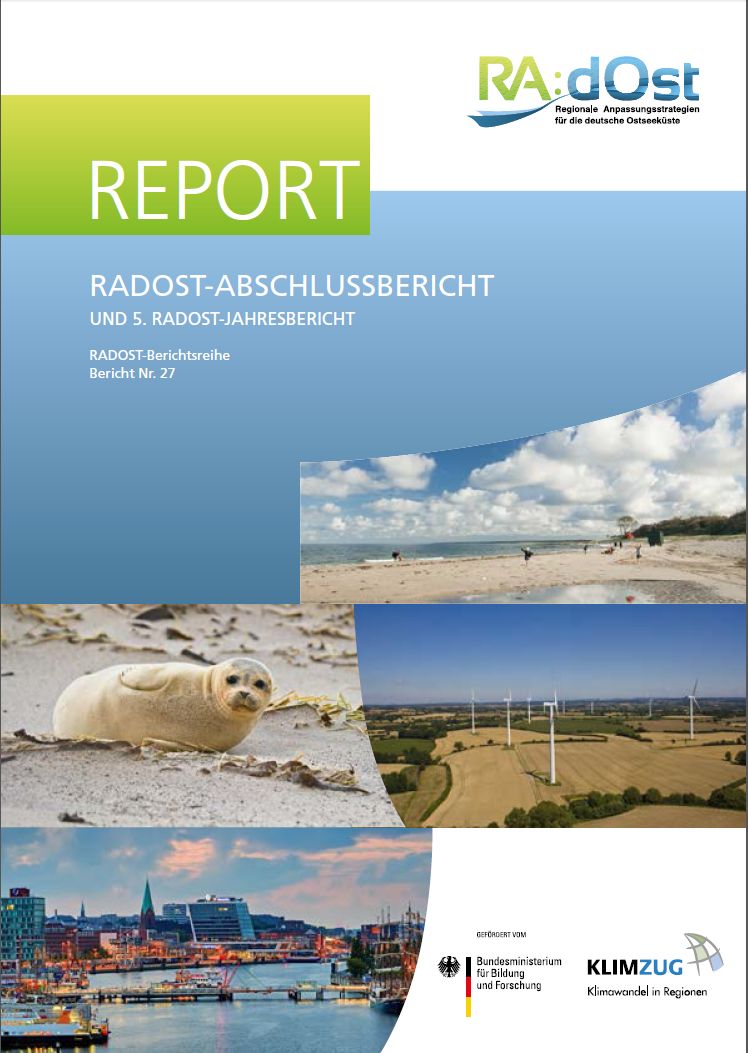
RADOST-Verbund (Ed.) 2014: RADOST-Abschlussbericht und 5. RADOST-Jahresbericht. RADOST-Berichtsreihe, Bericht Nr. 27. Berlin: Ecologic Institut.
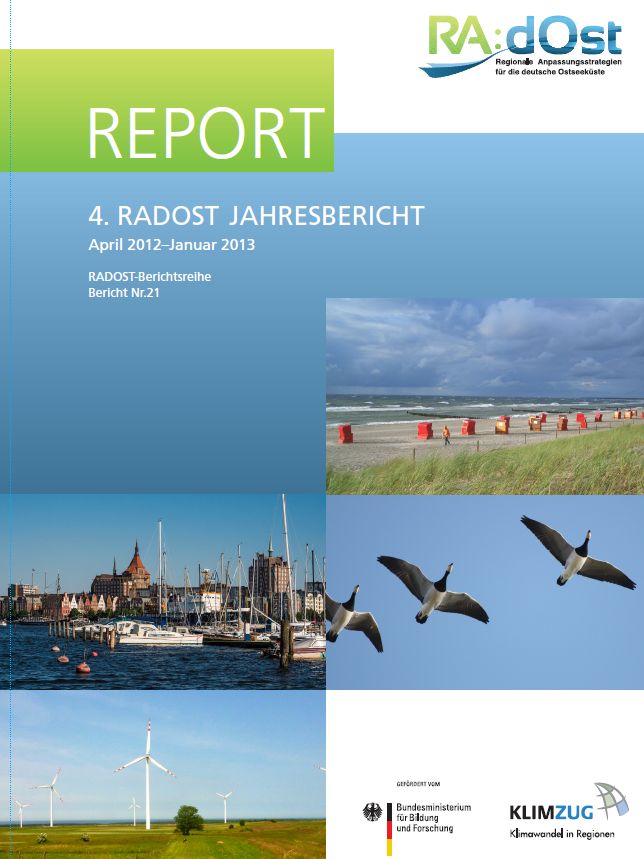
RADOST consortium (Ed.) 2013: 4. RADOST Jahresbericht. RADOST-Berichtsreihe, Bericht No 21. Berlin: Ecologic Institute.
RADOST consortium (Ed.) 2012: 3. RADOST Jahresbericht. RADOST-Berichtsreihe, Bericht Nr 14. Berlin: Ecologic Institute.
RADOST-Verbund 2011: 2. RADOST-Jahresbericht. Ecologic Institut (Hrsg.), Berlin. RADOST-Berichtsreihe, Bericht Nr. 3.
RADOST-Verbund 2011: 1. RADOST-Jahresbericht. Ecologic Institut (Hrsg.), Berlin. RADOST-Berichtsreihe, Bericht No 1.
Martinez, Grit; Daniel Blobel; Livia Bizikova and Rob Swart 2011: "Emerging Climate Change Coastal Adaptation Strategies and Case Studies around the World", in: Gerald; Hofstede Schernewski, Jacobus; Neumann, Thomas (ed.): Global Change and Baltic Coastal Zones Coastal Research Library, Vol. 1]. Berlin and Heidelberg: Springer-Verlag GmbH, 249-273.
Knoblauch, Doris; Zoritza Kiresiewa; Franziska Stuke and Anneke von Raggamby 2012: RADOST Akteursanalyse - Teil II: Auswertung der Befragung von Akteuren aus Politik, Verwaltung und Zivilgesellschaft. Ecologic Institute.