Industry
The transformation to a low-emission and resource-conserving economy is a particularly heavy challenge for industry. Industry accounts for a significant share of energy and resource consumption. At the same time, and unlike in energy supply, it is not enough to simply switch from fossil to renewable energy sources. What is needed are new technological solutions, new materials, value chains, and business models.
Increasingly, there are alternatives that promise success. Approaches include material efficiency and circular economy, the use of bio-based raw materials, but also the electrification of processes or the use of green hydrogen. However, few approaches have been tested. They are at the beginning of the learning curve and therefore, in most cases, still more expensive than conventional alternatives. Simultaneously, they are associated with greater risks. Therefore, instruments are needed to bring promising technologies to market maturity and thus advance the industry's transformation to climate neutrality. To this end, Ecologic Institute is developing innovative solutions.
Ecologic Institute's recommendations focus on economic instruments. Emissions trading schemes as efficient and effective instruments are important drivers for the transformation of industry. However, their suitability for promoting innovation is limited: Additional instruments such as carbon contracts for difference are needed to bring technologies to the market. Public investment in infrastructure or public innovation funds can also be supporting pillars of a successful transformation strategy. At the same time, changes in firm strategies can take place, for example by promoting bio-based business models along the value chain. With detailed analyses, Ecologic Institute shows how such instruments and strategies can look like.
Ecologic Institute's staff research the theoretical foundations of economic instruments and their application in industrial policy. To this end, the Ecologic Institute's industry team produces scientifically sound studies, develops pragmatic policy recommendations, organizes stakeholder dialogues, and presents the study results in various event formats. The team works closely with a wide range of stakeholders from science, industry, and politics at national and European level.






Selected Projects for Industry
Energy Intensive Industries: Challenges and opportunities in energy transition
- Duration
-
-
- Funding
-
European Parliament (EP), International
Carbon Contracts for Difference for Industrial Transformation
- Duration
-
-
- Funding
-
Agora Energiewende, Germany
Analysis of the Competitive Situation and the Carbon Leakage Risk of European Industries
- Duration
-
-
- Funding
-
German Environment Agency (UBA), Germany
Support to the Review of the EU Emissions Trading System
- Duration
-
-
- Funding
-
European Commission, Directorate-General for Climate Action (DG Climate), International
A "Fit for 55" Package Based on Environmental Integrity and Solidarity
- Duration
-
-
- Funding
-
Agora Energiewende, Germany
A Framework for Member States to Support Business in Improving its Resource Efficiency
- Duration
-
-
- Funding
-
European Commission, Directorate-General Environment (DG Environment), International

Improving the Market Access of Sustainable Bio-based Products (BIOBRIDGES)
- Duration
-
-
- Funding
-
Bio-Based Industries Joint Undertaking (BBI JU), International European Commission, Directorate-General Research & Innovation (DG Research & Innovation), International
Support to Research and Innovation Policy for Bio-based Products (BIO-SPRI)
- Duration
-
-
- Funding
-
European Commission, Directorate-General Research & Innovation (DG Research & Innovation), International
Selected Publications for Industry
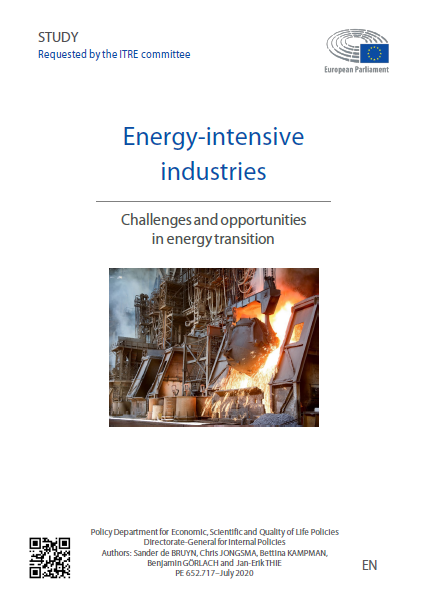
de Bruyn et al., S, Energy-intensive industries – Challenges and opportunities in energy transition,study for the committee on Industry, Research and Energy (ITRE), Policy Department for Economic, Scientific and Quality of Life Policies, European Parliament, Luxembourg, 2020.
Görlach, Benjamin and Elizabeth Zelljadt (2019): Carbon Leakage Risks in the Post-Paris World. UBA Climate Change 43/2019. Dessau-Roßlau: Umweltbundesamt
Agora Energiewende and Ecologic Institute (2021): A "Fit for 55" package based on environmental integrity and solidarity: Designing an EU climate policy architecture for ETS and effort sharing to deliver 55% lower GHG emissions by 2030, Berlin: Agora Energiewende.
Hirschnitz-Garbers, M., Hinzmann, M., Watkins, E., ten Brink, P., Milios, L. and Soleille, S. (2015). A framework for Member States to support business in improving its resource efficiency. Final Report for DG Environment, November 2015.
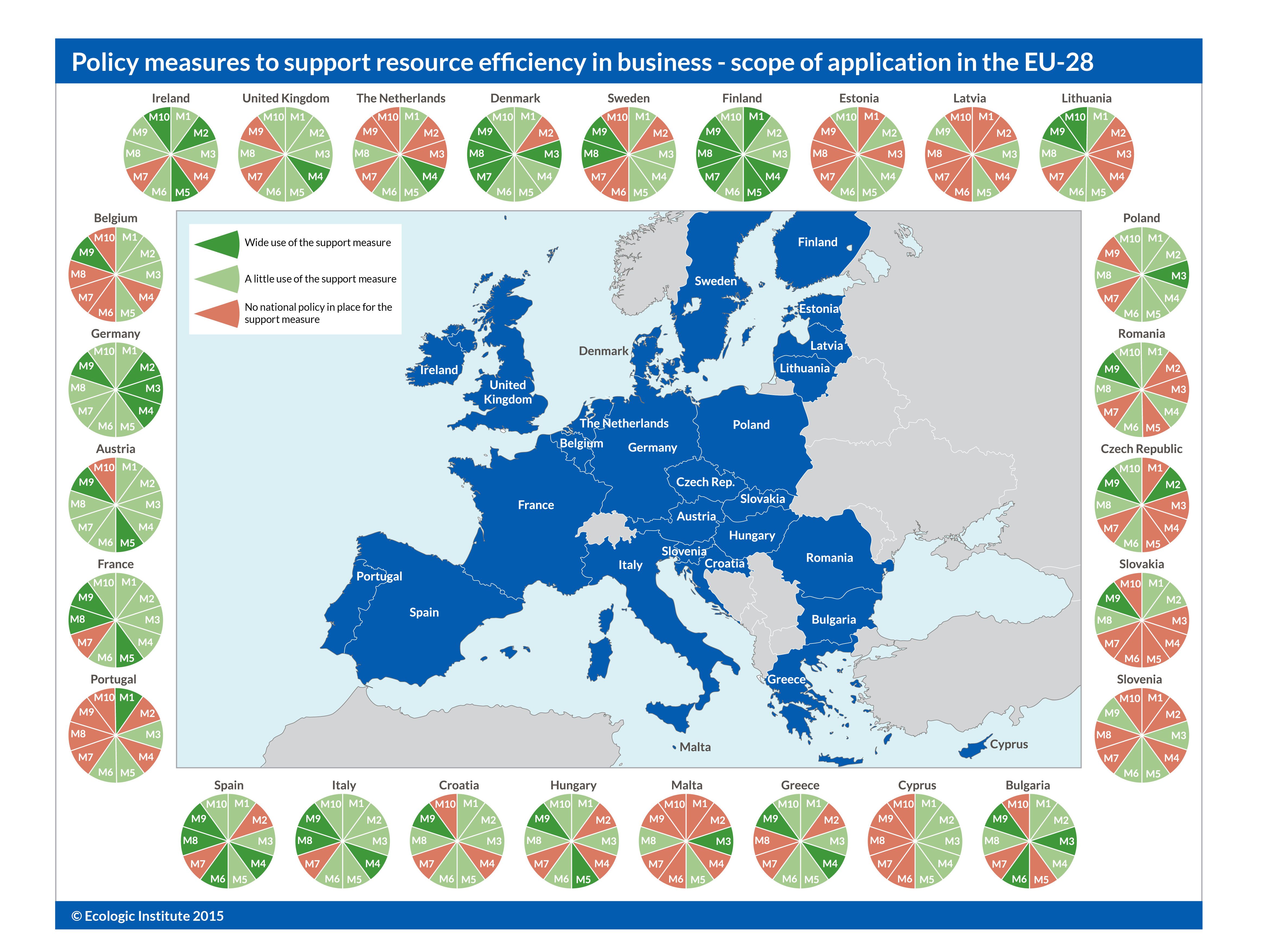
Hirschnitz-Garbers M. und Welk Vargová B. (2015): Good Practice Example and Scope of Application of the ten Support Measures across EU-28. Infographic published in: Hirschnitz-Garbers, M., Hinzmann, M., Watkins, E., ten Brink, P., Milios, L. and Soleille, S. (2015). A framework for Member States to support business in improving its resource efficiency. Final Report for DG Environment, page 59 f.
Vasileios Rizos, Arno Behrens, Wytze van der Gaast, Erwin Hofman, Anastasia Ioannou, Terri Kafyeke, Alexandros Flamos, Roberto Rinaldi, Sotiris Papadelis, Martin Hirschnitz-Garbers and Corrado Topi, "Implementation of Circular Economy Business Models by Small and Medium-Sized Enterprises (SMEs): Barriers and Enablers", Sustainability 2016, 8(11), 1212, doi:10.3390/su8111212
Ecologic Institute 2018: Top Emerging Bio-based Products, their Properties and Industrial Applications. Berlin.
Ecologic Institute 2018: Bio-based Products – from idea to market. 15 EU success stories. Berlin.